
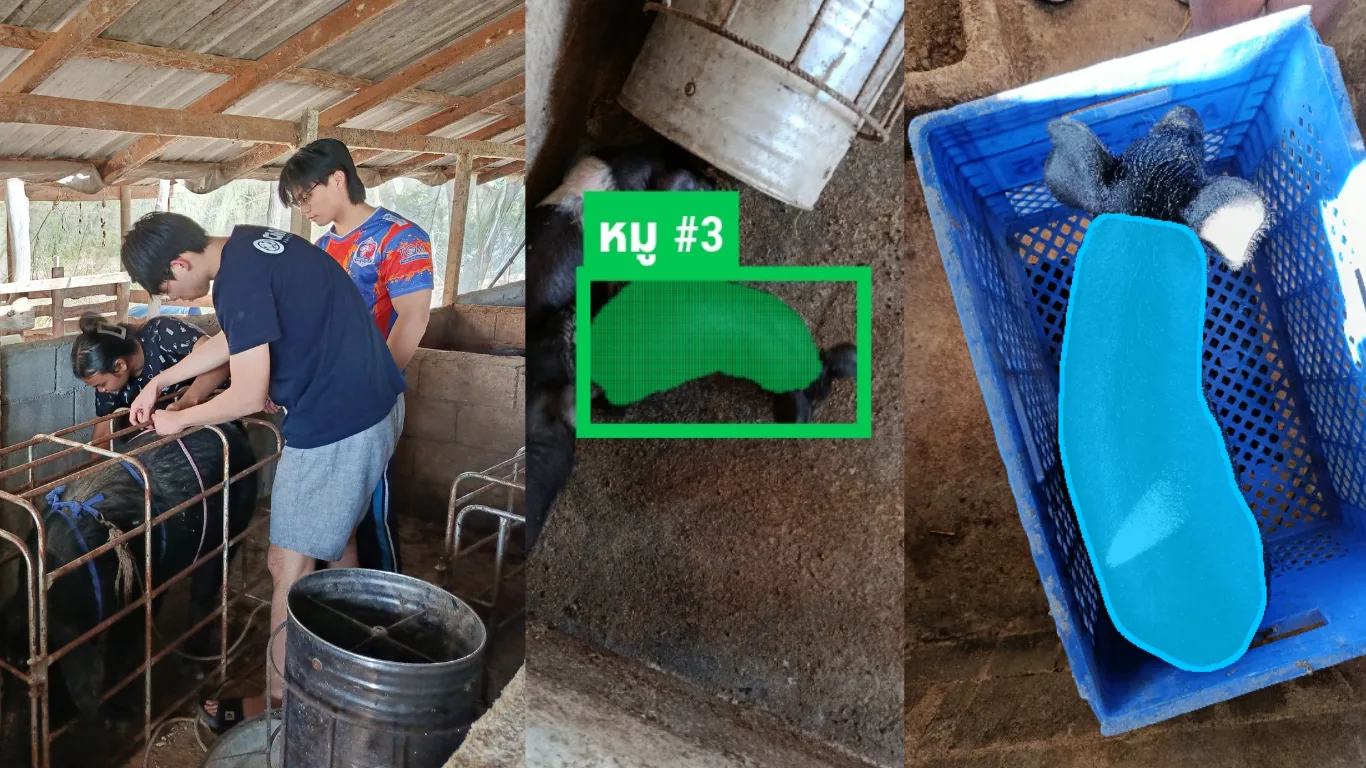
In Karen and Muser communities, Chiang Mai black pigs are more than livestock. They are connected to household income, food, rituals, ceremonies, and community life. For farmers, knowing a pig’s weight is important for fair pricing, feeding, and care. Yet accurate weighing is difficult in remote mountain villages where digital or mechanical scales may be expensive, unavailable, or impractical.
DooMoo was developed by CMKL students Phurich Amornnara, Phasin Noomkan, Thanakit Thanasuwanditee, Puttipong Srisuwantat, and Chayenchanadhip Sevikul under the guidance of Dr. Boonyarit Changaival. The project proposes a low-cost, contactless way to estimate pig weight using a smartphone camera.
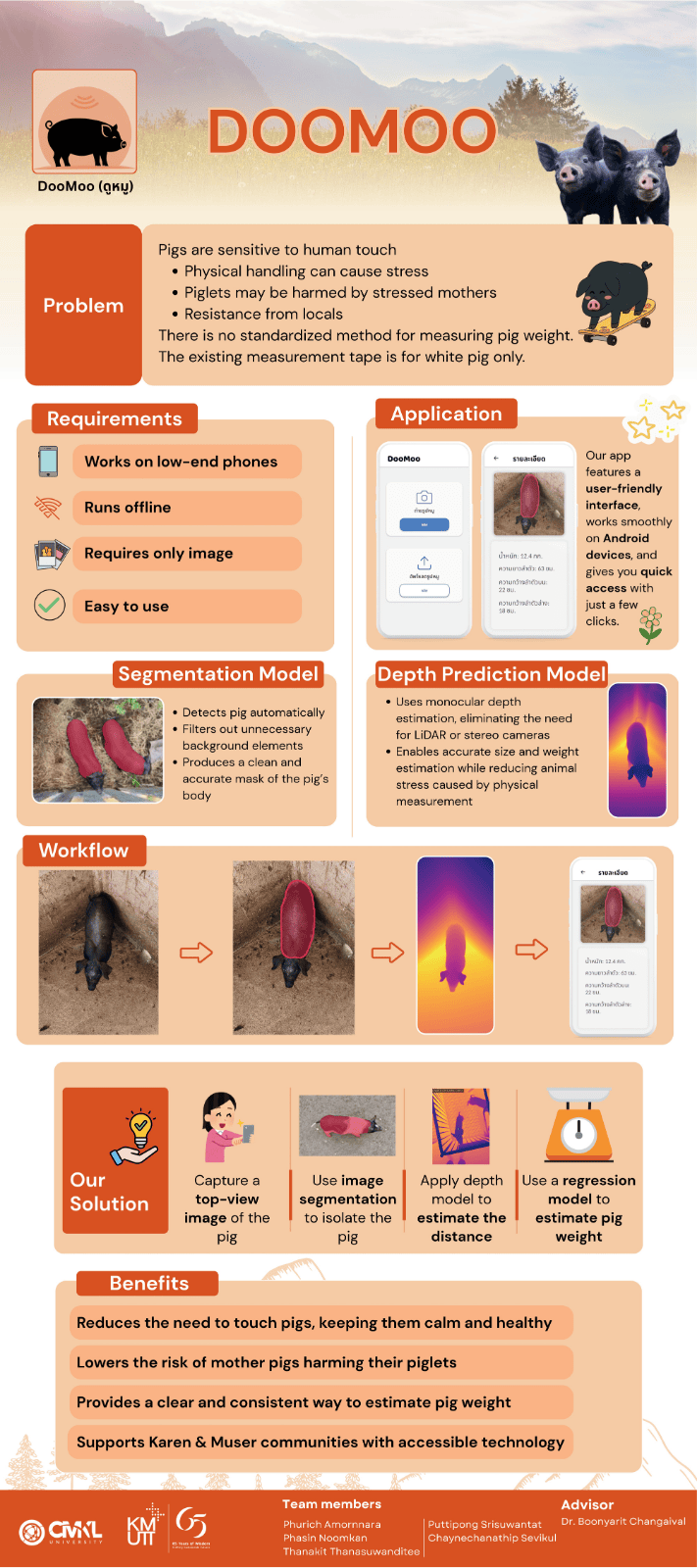
The team built a mobile AI system that allows users to capture a top-view image of a pig and receive an estimated weight. This reduces the need to physically restrain the animal, which can be stressful for pigs and risky for farmers. Young pigs are especially sensitive to handling, and excessive contact may affect their behavior, growth, or relationship with the mother pig.
The technical pipeline begins with pig detection using YOLOv8n. Once a pig is detected, an RF-DETR Nano segmentation model isolates the pig’s body from the background. The system then extracts body measurements from the segmented image, converts pixel dimensions into real-world units using camera geometry, and applies a regression model to estimate weight.
A key design requirement was offline usability. Some farming areas have limited or unreliable internet access, so the system was designed to run directly on a mobile device. During testing, the team deployed the pipeline on a mid-range Android phone and achieved approximately four seconds of end-to-end inference time per pig.
The project also revealed the challenges of building AI for real-world field conditions. Lighting, shadows, camera angle, pig posture, motion, and occlusion can all affect segmentation and measurement accuracy. The team identified posture and height estimation as important areas for further refinement.
DooMoo is a strong example of AI for community impact. It connects computer vision, mobile deployment, agriculture, animal welfare, and rural livelihood support. More importantly, it shows how students can design technology around the real constraints of the people and communities it aims to serve.

.png)
.png)
.png)
.png)
.png)