
Folkcharm is a Thai social enterprise known for rain-fed cotton, hand-spun yarn, handwoven textiles, natural dyes, and artisan production. Its supply chain is already built around sustainable practices, but the company faced a practical communication challenge: how could it express that advantage as consistent, per-product carbon estimates?
The Folkcharm Carbon Calculator was developed by CMKL students Phyo Theingi, Jakrin Strickland, Shinn Thant Khin, and Bawornpat Rattanapongkiat, with Prof. Antoine Merlet and Prof. Buraskorn Torut as advisors. The project gives Folkcharm a staff-facing tool to estimate cradle-to-gate carbon emissions for individual products.
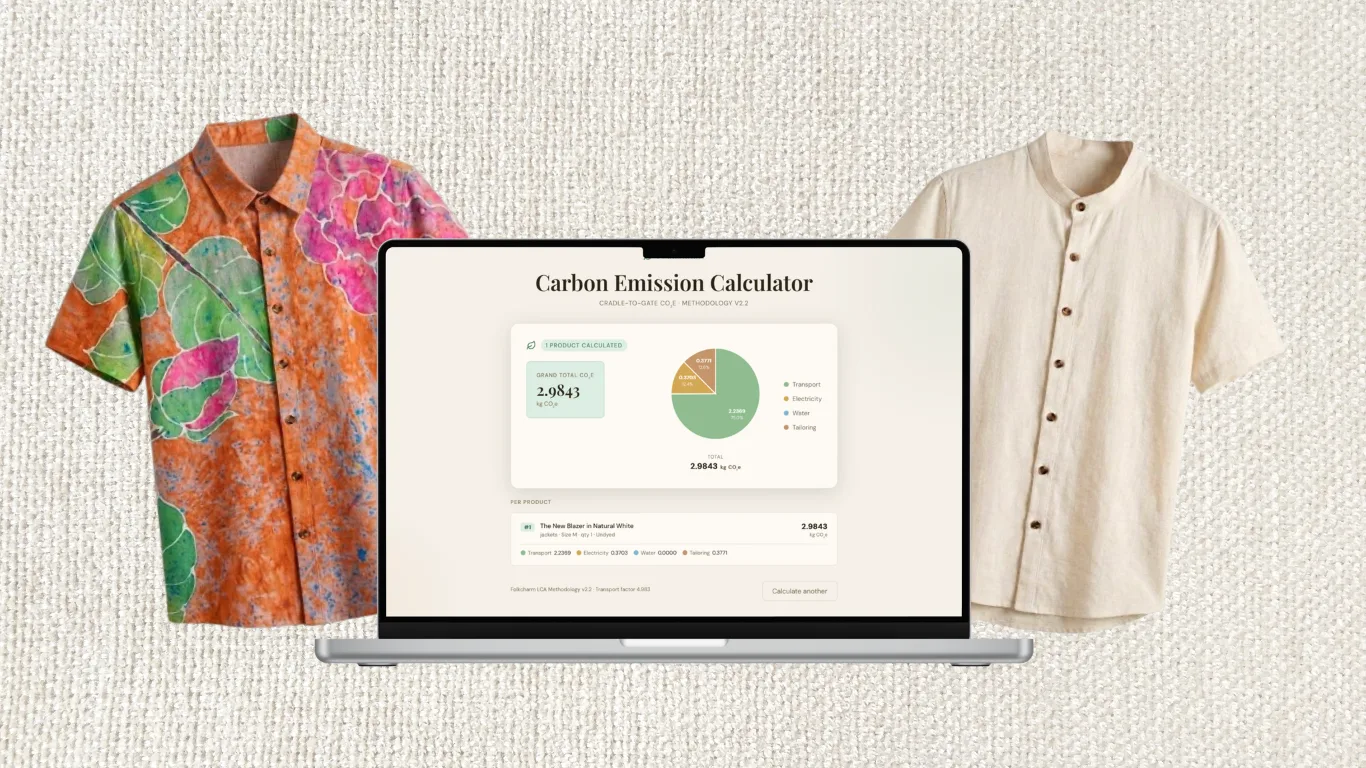
The team built a web-based calculator where staff can select a product name, size, and quantity. The system then calculates estimated CO₂e emissions and provides a breakdown by stage, such as transport, studio electricity, water use, and tailoring.
The project was not only a software challenge. It required the team to understand life-cycle assessment methodology, emission factors, system boundaries, product classification, and the difference between defensible estimates and public certification claims. The methodology follows a cradle-to-gate boundary, covering production-side impacts up to the point where the finished product leaves the studio.
Technically, the calculator uses a React frontend deployed on Vercel, with Google Sheets acting as a live data source. This architecture separates calculation logic from maintainable data. Folkcharm staff can update product information, emission factors, or assumptions in the spreadsheet without needing to redeploy the application.
One of the project’s key findings is that transport dominates the estimated footprint under the current assumptions. This is a useful insight because it points to logistics as a major lever for reducing emissions, rather than focusing only on studio electricity or handcraft production stages.
The project also includes comparisons with published Thai textile life-cycle assessment references, helping Folkcharm place its results in context. At the same time, the team carefully distinguishes between student-built estimation and third-party verified carbon labeling.
This project demonstrates how software engineering can support sustainability, transparency, and responsible business communication. It also teaches an important lesson: in applied sustainability work, the methodology is as important as the interface.