
Creating a school timetable is a deceptively difficult task. A complete schedule must consider teachers, classrooms, subjects, time slots, student groups, institutional rules, and many exceptions. In many schools, this process is still done manually, often taking days or weeks of trial and adjustment.
ScheDool was developed by CMKL students Nunthatinn Veerapaiboon, Thanawin Pattanaphol, Atchariyapat Sirijirakarnjaroen, Nachayada Pattaratichakonkul, and Petch Suwapun, under the guidance of Dr. Charnon Pattiyanon. The project aims to help Thai schools create timetables more efficiently through an automated, editable, and constraint-aware scheduling platform.
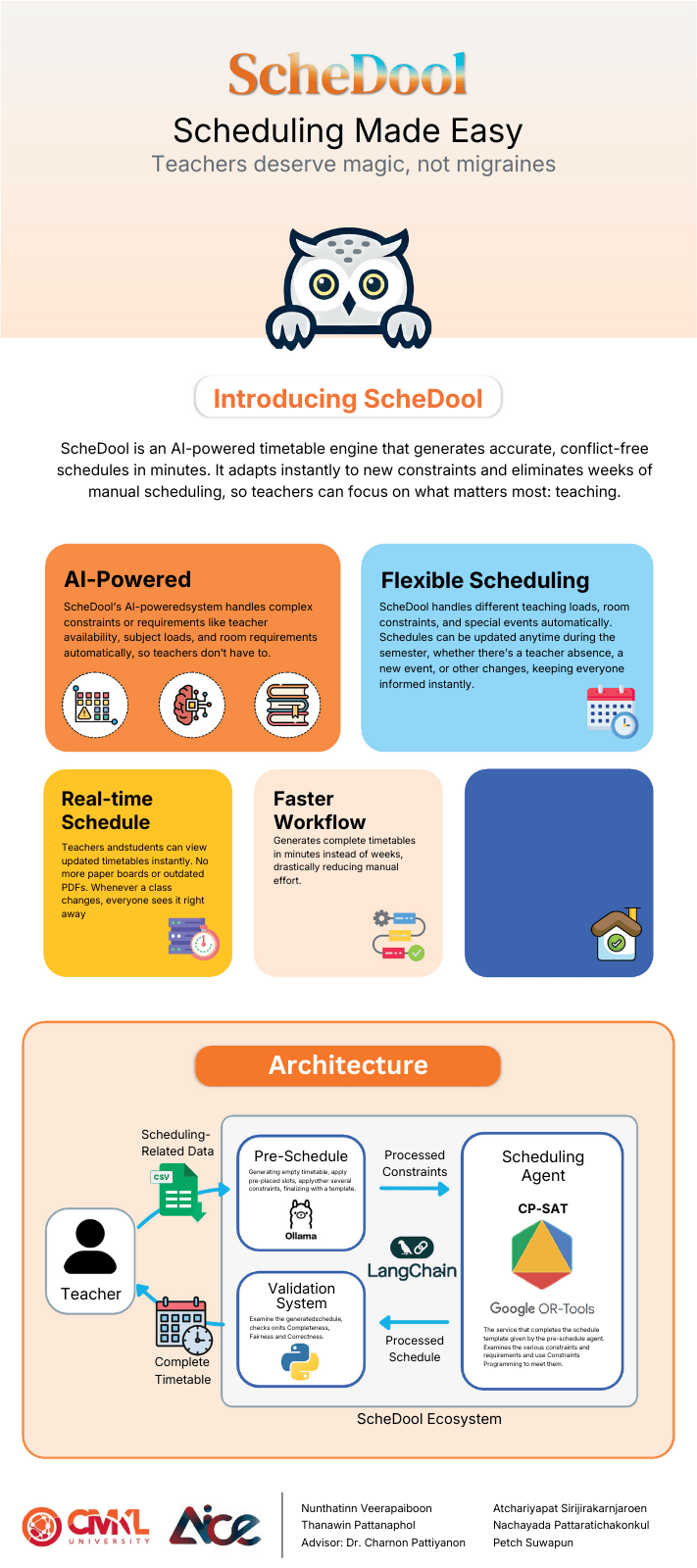
The team built a SaaS-style platform where school staff can input scheduling information and generate timetable options. The system supports teacher assignments, subjects, rooms, and constraints, while also allowing users to review and edit the generated schedules through a dashboard.
At the technical level, ScheDool uses a genetic algorithm to search for feasible timetable solutions. Scheduling problems can quickly become too complex for simple rule-based generation, especially when multiple constraints interact. A genetic algorithm allows the system to explore many possible combinations and gradually improve toward better schedules.
The team also explored the use of LLM-assisted preprocessing to convert human-readable constraints into structured scheduling rules. This is important because school administrators may not naturally think in formal constraint language. A practical scheduling tool must bridge the gap between how users describe their needs and how optimization engines process them.
ScheDool is a strong example of applied AI and optimization in education operations. It does not focus on replacing teachers or changing classroom learning. Instead, it supports the administrative systems that allow schools to run more smoothly.
For CMKL students, the project demonstrates how algorithms can be applied to real institutional workflows. It also shows that successful AI systems often require more than technical accuracy. They must be understandable, editable, and useful for the people who will work with them every day.

.png)
.png)

.png)
.png)